
During a recent session, I was shown Roche’s map of biochemical pathways. It looked like an enormous subway (tube for any British readers) map, depicting the intricate connections between so many processes within the body. It’s an image that really spoke to me, particularly when I think about the expectation we can place on one thing to “fix” our stress.
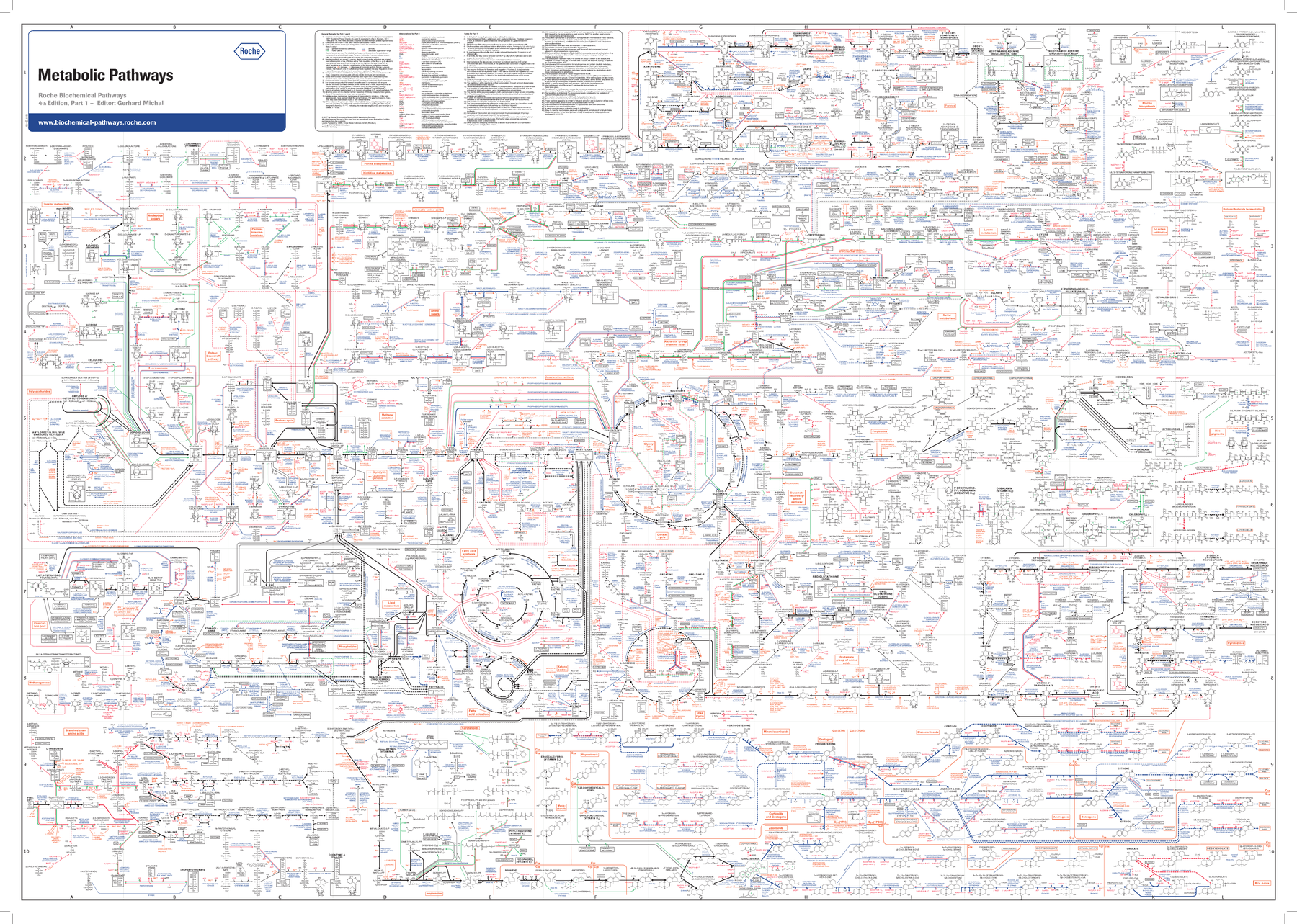
Roche’s map of metabolic pathways, illustrating the intricate connections between biochemical reactions.
Roche Biochemical Pathways, Metabolic Pathways, 4th Edition, Part 1. Editor: Gerhard Michal.
Most people can recognise when stress is all-consuming and they need to support themselves using practices such as Breathwork, which I personally love! These types of tools can help you potentially feel more relaxed and certainly provide a moment to pause, and get into your body, when everything feels a bit too much. However, if we’re still experiencing stress, it’s easy to start to wonder whether you’re doing it properly, or if another tool or technique is needed.
From my personal experience, I have learnt that there might be something else to consider before we move onto the next thing. And that is to consider….what are we actually expecting this one singular practice to do?
Roche’s map isn’t a map of stress, it shows interconnected chemical reactions and gives us a glimpse of the complexity of biological processes, including many that happen within us. Similarly, stress can have effects across multiple bodily systems, including our nervous, hormonal and immune systems. One small change or practice, absolutely can help. But, we may be asking too much of it if we expect it to do all the work and completely reduce our stress levels. I have had to learn this for myself, and have recently come to the realisation, that for me, I need to take a more holistic view of what supporting myself means to positively impact my stress levels. Perhaps supporting ourselves is like a choreography of small moments throughout the day which supports my overall performance. Instead of relying on Breathwork alone, it’s considering the decisions we make, the boundaries we choose to set, and the practices we integrate to help us relax.
Honestly, this journey might need to begin with you opening up your awareness of yourself, your body and your stress levels. Often, some people don’t truly realise how stressed they might be. I recall disagreeing with doctors who suggested that I'd become so accustomed to ongoing stress that my recognition of it had changed, when I believed I didn’t feel stressed at all. What I hadn’t realised (which my doctor kindly pointed out) was that my baseline for stress had shifted, and along with that my awareness of it. I’ve since considered how living with ongoing stress may have changed what I recognised as normal.
One small change or practice, absolutely can help.
I’m fairly confident some of you have had similar conversations, and some may relate without actually needing the discussion to take place. There’s a lot going on, there always is, and you’ve become accustomed to managing it. You’re probably used to finishing one thing and moving straight onto the next, and I’m quite convinced that in those rare moments of quiet, you’re still thinking about what else needs to get done….if you’re like me, you probably have 50 different tabs open in your brain at once! It might take someone else to highlight to you that you might need to slow down, for you to realise perhaps you don’t know how to.
For some, pressure and hard work are also tied to feeling productive. Those individuals are fantastic at dealing with deadlines, or something urgent to manage. That intense pressure, stress and constantly working with time constraints may unconsciously light you up. In fact, you might secretly love it and thrive in that type of high stress environment. You probably fill your relaxation time with things to do, even while secretly wishing you had more time to relax. Describing yourself as stressed may not quite feel right when this has become your usual way of operating.
There is no need to make a judgement about yourself here, we do not need to add weight to this realisation. Instead, you can use this to bring an element of awareness into your world. I’d encourage you to consider if you have any space in your day to recover from what the day is asking of you.
This is where that choreography becomes more practical. The Breathwork tool may be helping you, while the workload still needs a conversation of its own. These things can support each other, and what’s useful will depend on what you’re carrying. Ultimately, you can use your chosen tool to support relaxation all day long, but if the stressors remain, is it possible to actually achieve balance?
Describing yourself as stressed may not quite feel right when this has become your usual way of operating.
I am very aware from my own life experience that some pressures are difficult to change. There will almost certainly be responsibilities that you can’t put down or delegate, and I imagine there will be circumstances which you have very little influence over. A considered, realistic and consistent approach needs to make room for that too, including support from other people or a professional where it’s needed.
Additionally, we also have our own unconscious patterns that we bring to difficult moments. One unconscious pattern that I am bringing to my conscious awareness to work with, is the urge to keep researching something uncertain, such as a strange symptom I’m experiencing in my body. Typically I fall into the loop of sensing the symptom, focusing on it, thinking about it, researching a solution, and spiralling into a world of possibilities without the guidance of a professional, and trying to find an answer I’m not equipped to give myself. I have begun to recognise that sometimes the most useful thing I can do is leave the phone alone, and sit with the uncertainty. I still take the concern seriously, I’m simply trying to avoid adding more weight to it.
For yourself, it may be noticing that you’ve yet again agreed to something before taking a moment to consider if you have the time. Or perhaps, you keep responding to those work emails late into the evening when you’d intended to finish with dinner. You do not need to change every pattern at once, instead, give yourself permission to bring awareness into your day and recognise one pattern to focus on interrupting, and consider a different response.
If you have a little space to reflect, you might begin with whichever question feels most relevant to you.
What have you become so used to carrying that you no longer think of it as stressful?
When you have a moment to pause, what makes it difficult to let yourself stop?
Alongside the practices that help you relax, is there a pressure that needs a boundary, a conversation or some support?
This is not intended to become another list of things to do within an already full day, and if it feels like it’s adding pressure, perhaps leave this technique until you’re ready to revisit. If you do have the capacity to reflect, start with what you notice in your life, keep the practices that help, and give attention to the pressures that they’re helping you carry. You may find something that you’ve been treating as normal, which deserves a little more support than you’ve been allowing.
You don’t have to carry it all alone.