
Why is it that one day it’s easy to connect and engage with a person, and the next day it can feel like hard work? Is it you? Is it them? Is it both?
Many things can influence why connection and the ease of engagement fluctuate. One area to consider, and one that often passes us by unconsciously, is a person’s “motivational state”.
The motivational state a human being is in can determine how they act, what they want from a situation, and how they communicate. What they found funny and engaging during a conversation yesterday may have shifted, and today you sense they’re almost annoyed by a similar dialogue. This moment can send people into a panic that they’ve done something wrong.
Addressing the immediate self-blame and judgement that you’ve done something wrong is for another article. We’ll come back to that another time. For now, let’s focus on what I mean when I say “motivational state”.
About a decade ago, I was introduced to Reversal Theory by Michael Apter. His theory suggests that our motivations and emotions shift between opposite states, such as serious and playful. What we want when we’re in each of those states changes. This means we could experience the same moment twice, and the state we’re in could alter what we want from that moment and how we respond to it.
One pair of states he identified is Telic and Paratelic.
Telic is the more focused, serious state, often driven by a goal or time pressure.
Paratelic is more playful. It wants to enjoy the experience of what’s happening and is usually more sensory.
For ease of everyday application, we’ll use “Focused” to describe the more goal-driven motivational state, and “Playful” for the more relaxed, experiential state.
The level of stimulation we want also changes depending on the state we’re in. When we’re FOCUSED, too much happening at once can feel overwhelming and create anxiety, while less stimulation can help us feel calm and relaxed. When we’re PLAYFUL, the opposite can be true. Too little stimulation can quickly become boring and cause us to disengage or leave, while a lively environment with lots happening can feel exciting and enjoyable.
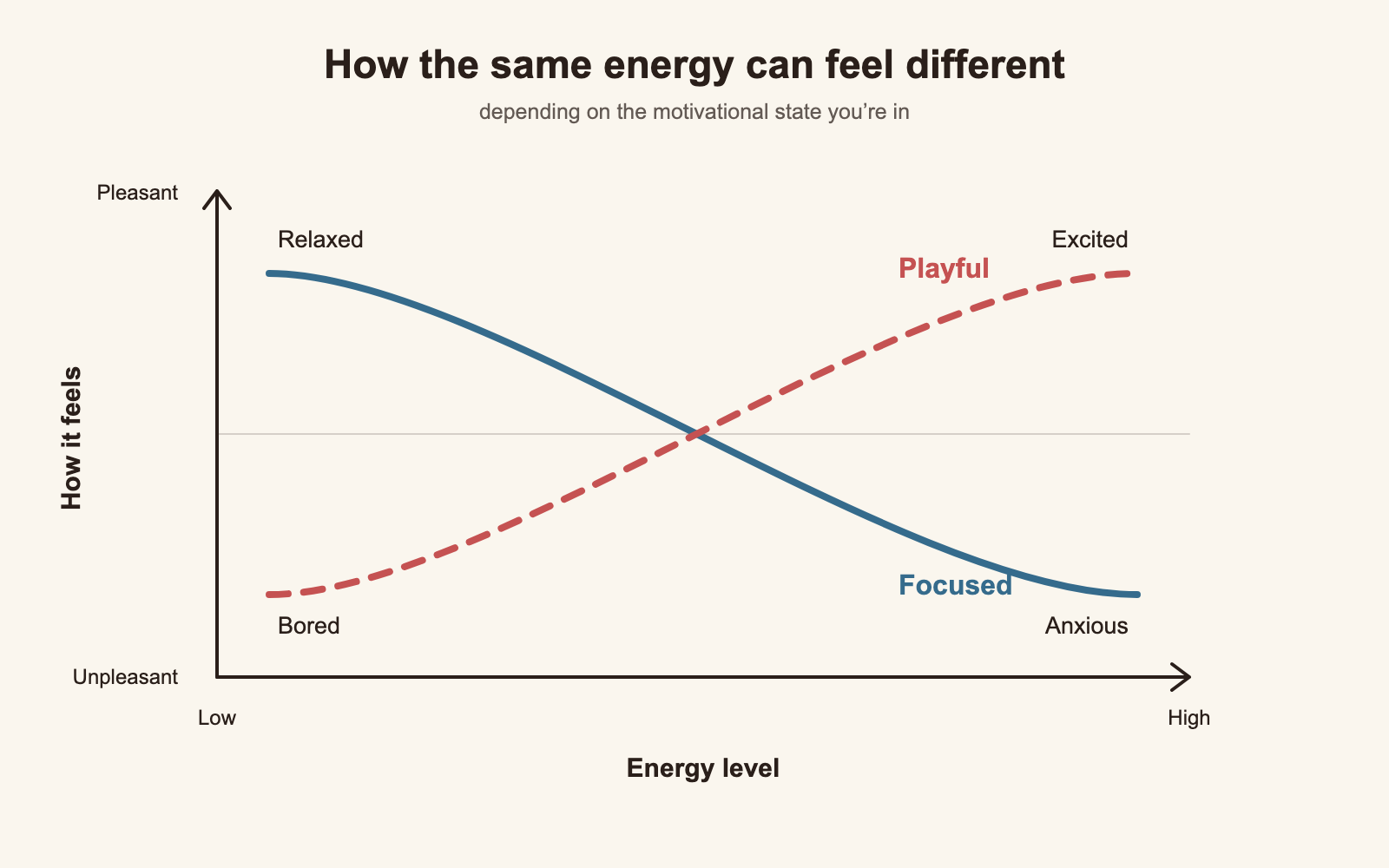
The level of stimulation we want also changes depending on the state we’re in.
To add another layer of consideration, the theory was labelled Reversal Theory because we can quickly reverse, or flip, from one state to another. Perhaps, once a person has completed a task or achieved an immediate goal, they flip from “Focused” into “Playful”. They immediately relax and change the way they’re interacting with people.
Let’s apply this to everyday life.
Imagine this…
You’re heading to the airport to catch a flight, and you’re running a little later than you’d like.
You’ve just entered the terminal, and your brain is FOCUSED on scanning for the information you need to find your check-in desk. You are goal-focused on dropping off your bags and checking in. You see that there’s a large queue for the bag drop, and you immediately start to feel a little anxious. You’re calculating the timing of everything and working backwards in your head. Perhaps, if you have children with you and they’re jumping around, you might find yourself being a little short or direct when asking them to sit still.
You finally drop your bags off, but now you have to head to security, where, of course, there is another queue. Your breath is shallow. You’re attempting to get any items out of your bag that you need to have ready to pass through security. You’re checking that the kids have emptied their water bottles. You’re ticking off your to-do list and constantly scanning the environment for information to understand how long this will take.
You finally make it through security with plenty of time, and you instantly take a deep breath and flip into a more relaxed, PLAYFUL state. You go and grab some food or a coffee. Your breath has deepened, and now you don’t feel as irritated by the children who have an abundance of energy. You’re enjoying the engaging and experiential environment of the terminal.
Now, your gate is about to open, and you flip back into a FOCUSED state. While there is a time-sensitive nature to this, you’re not stressed because you know you’re nearby. So, while you’re focused, you’re not stressed; you’re simply task-driven. You walk intentionally and arrive prepared to board the plane.
Once everyone is on and you know your hand luggage fits comfortably in the overhead compartment, you flip back into PLAYFUL. You’ve done your part. The flight is now something you don’t control, so you relax, put your headphones on, and perhaps enjoy a plane picnic!
This example shows clear reversals between states, but it’s a very real example that many people can relate to.
Being in a FOCUSED state does not always mean being stressed. In fact, as someone who is naturally a very “Telic” human, I get a tremendous amount of joy from being in a focused state. I achieve a lot, and I like that.
Being in a PLAYFUL state does not mean you are not goal-driven. It simply means you want to enjoy the experience along the way to reaching that goal.
If you recall, the kids had an abundance of energy while you were experiencing both states. The way you responded to them was different depending on the motivational state you were in and what you needed at that moment.
This is similar to what happens constantly in our lives, and this is where knowing about these two motivational states can change your understanding of why someone might be responding in the way they are.
I work with teams and companies to help them understand motivational states and how to apply that understanding to communication, harmony, and empathy. It doesn’t act as an excuse for someone being an arse. What it does do is help teams or groups of people understand why they might be responding in different ways and remove some of the emotional charge attached to that.
When my global team reported to me, I taught them about this theory, and it became part of our language. As someone who truly cares about the people who work for me and who they are in their lives, it is usual for me to want to check in with everyone at the beginning of a call.
However, there were times when I had a time-sensitive project and was incredibly FOCUSED, and I did not have the capacity to engage as I usually would. So, I would let the team know: “Hey everyone, I’m in a very Telic/Focused state today because I have a deadline, and I’ll likely be more direct in my responses. Please let me know if there’s anything you need from me that I don’t provide today, and I’ll make sure you have that support.”
Being FOCUSED or PLAYFUL is not good or bad. It is simply the motivational state a human being is in. FOCUSED is driven more by a goal or task-focused environment, whereas PLAYFUL is led more by experience and enjoying the journey. We all do both, and we all flip between both.
Being FOCUSED or PLAYFUL is not good or bad. It is simply the motivational state a human being is in.
Sometimes, it can feel confusing to witness someone switch between the two, but it’s a reflection of their motivations changing in real time. So, perhaps the reason a colleague could joke around and have banter yesterday but seems standoffish in comparison today may have less to do with you and more to do with the motivational state they’re in.
If you feel there is someone who yo-yos in how they engage with you, become curious about what they are focused on during those changes. Are they up against the clock? Are they trying to complete a task? Or are they more relaxed, enjoying their environment and interacting with the things around them?
Before you assume their change in energy is personal, pause and ask what they might be focused on in that moment. Then become curious about your own motivational state and how you’re moving between the two.
A change in someone’s energy can quickly become a story about what we’ve done wrong. Pausing long enough to consider the state they may be in can create room for a different interpretation.
Think of a recent moment when someone felt more distant or direct than usual. What did you assume it meant?
What might they have been focused on or trying to complete in that moment?
How does your own communication change when you move between Focused and Playful states?
What could you communicate more clearly when you know you are in a highly Focused state?
Before you assume it’s personal, leave room for what you can’t yet see.